
Therapy treatment table
Electric therapy tables and treatment tables are essential equipment for physiotherapy, massage, osteopathy and manual therapy. In our shop, you will find height-adjustable models designed for comfortable, back-friendly work — choose the right therapy table for your practice.
Electric or hydraulic — which table suits the way you work?
An electric therapy table can be adjusted smoothly to the right height using a foot switch — without physical effort, even while the patient is lying on the table. This is especially useful when treating many patients a day and helps reduce strain on your joints. A hydraulic treatment table works without electricity and can be placed freely in the room where you need it — ideal for manual therapy and osteopathy.
Show more »
What to look for when buying a treatment table +
- Height adjustment: electric or hydraulic adjustment supports back-friendly work in every position.
- Load capacity: a stable construction provides safety during firm techniques and for heavier patients.
- Upholstery: skin-friendly, oil-resistant upholstery is hygienic, comfortable and durable.
- Sections: 2-section, 3-section and multi-section tables allow many patient positioning options.
- Use: suitable for physiotherapy clinics, massage practices, osteopathy and medical treatment rooms.
All models in this category are built for daily professional use. Choose the right treatment table for your practice — we offer free delivery within Germany.
Frequently asked questions about therapy tables
Which therapy table is suitable for physiotherapy? +
For a busy physiotherapy practice, an electric height-adjustable therapy table is often the best choice. It allows you to adjust the working height quickly and without effort, supporting ergonomic work throughout the day.
Which is better: an electric or hydraulic treatment table? +
An electric treatment table offers maximum convenience because the height can be adjusted using a foot switch. A hydraulic table works independently of electricity and is ideal when the table needs to stand freely in the room or when you work mainly with manual therapy.
What should you consider when buying a therapy table? +
The most important factors are stability, load capacity, height adjustment, upholstery quality, the number of table sections and the intended use — for example physiotherapy, massage or osteopathy.


Buying a therapy couch: This is how to find the right therapy couch for your practice

Learn more about therapy tables:
Electric or hydraulic: Which height adjustment makes sense?
Hydraulic Treatment Tables - Self-sufficient and Flexible
- Advantage: They are completely independent of power sources. This is ideal if the couch is to stand freely in the room or in the sling table.
- Suitability: Perfect for practices focusing on manual therapy or osteopathy, where the height does not need to be adjusted multiple times with every patient change.
Electric Treatment Tables - Comfort and Precision
- Advantage: The stepless adjustment is made without physical effort for you. This protects your joints and allows the patient to be raised absolutely smoothly.
- Suitability: Recommended for intensive daily practice with high patient frequency (e.g. physiotherapy), where back-friendly work is paramount.

Comparison of Hydraulic and Electric Treatment Couches
Feature |
Hydraulic Therapy Couch | Electric Therapy Couch |
|---|---|---|
Drive |
Manual pump mechanism (foot pedal) | Electric motor with hand or foot switch |
Power connection |
Not required | Mandatory |
Ease of Use |
Effort required when pumping | Effortlessly at the touch of a button |
Speed |
Depending on the pump frequency | Constant (engine-dependent) |
Maintenance |
Low (check oil level, seals) | Low to Medium (Check electronics) |
Flexibility |
Can be placed anywhere in the room | Bound to socket position |
Price |
Often slightly cheaper in the base model | Higher purchase price |
What is the optimal width for a therapy couch?
The ideal width for therapy couches is usually between 66 and 75 cm. This range offers the optimal compromise between patient comfort and an ergonomic working position.
Important for neurological treatments: (e.g., Bobath or Vojta) Due to special positioning techniques, wider surfaces of 80 to 120 cm (or more) are required here.
Expert Tip:
Make sure the couch is not too wide for your own height. An ergonomic working height is of little use if the width forces you into an unhealthy posture.

How many sections does a therapy couch need?
In the context of an electric therapy couch, segments refer to the division of the couch surface into multiple, independently adjustable sections. This division allows you to precisely adapt the couch to the anatomical needs of your patients and the requirements of your specific treatment method. Generally, the number of segments expands the treatment possibilities and ergonomics for both the therapist and the client.
Here is an overview:

Comparison: Treatment options with 2 - 5 segments on therapy couches:
▶︎ 2 Segments
2-section couches (headrest + long leg section) are the standard entry-level choice in the group of adjustable therapy couches.
2-section couches allow for a sitting position through the raising of the headrest, which is advantageous for shoulder joint mobilizations or arm exercises.
Many neurological or orthopedic tests (e.g., provocation tests or strength tests) require an upright, unstable, or functional sitting position.
▶︎ 3 segments
Couches with three segments allow for a roof position in addition to the seated position. For example, positioning in a V-shape provides relief for the lumbar spine. By raising the pelvis, pressure is taken off the lumbar spine. Furthermore, the roof position allows for adaptation to the client's anatomy by mimicking the natural curvature of the spine. The improved ergonomic working position is also an advantage.
▶︎ 4 Segments
4-section therapy couches are frequently used for treatments in the prone position. The 4 sections consist of an angle-adjustable headrest and lowerable armrests. Lowering them relieves the shoulder girdle in the prone position, resulting in ergonomic advantages for manual therapies and massage treatments.
▶︎ 5 Segments
5-segment treatment tables are the premium class. They combine all the features of the previous models in one therapy table. If several therapists with different treatment methods work on one table, a 5-segment table is the best choice. Lowerable armrests,
kyphosis position (roof position),
Trendelenburg position, chair position, or precise adjustment of the leg section. With this type of table, a wide range of ergonomic treatment options is available to you.
Our budget highlight with 5 segments

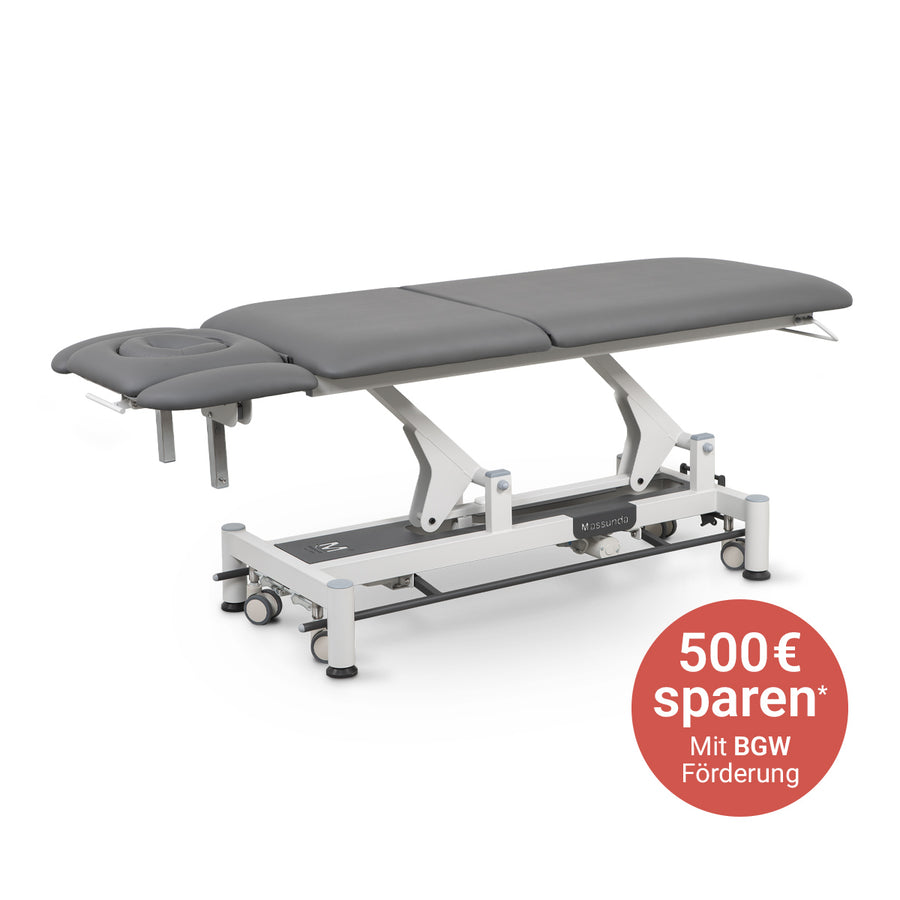


Get a therapy couch with a €500 subsidy
Older treatment couches pose massive entrapment hazards, and the Federal Institute for Drugs and Medical Devices (BfArM) therefore calls for strict safety precautions. When purchasing a new treatment couch, pay attention to integrated safety systems (e.g., freewheel clutch or double-tap function). The Employers' Liability Insurance Association (BGW) provides a one-time grant of 500 Euros towards the purchase price. The prerequisite is that the safety standards of the new treatment couch exceed those of the BfArM.
Learn more about the requirements and which couch is eligible for funding:

FAQ - Frequently Asked Questions
What should I consider when choosing upholstery for manual therapy or osteopathy?
For manual therapy or osteopathy techniques, firm padding with high padding density is crucial. A too-soft surface would dampen the targeted impulses and mobilizations, reducing the precision of the treatment. Especially for treatment couches used in physiotherapy, we recommend couches that offer stable resistance without neglecting patient comfort. 5 to 7 cm has proven to be effective here. For electric massage tables, padding thicknesses of 7-8 cm are also common.
What is the difference between static and dynamic load capacity?
The static load capacity indicates how much weight the couch can support when at rest. Much more important for your everyday practice, however, is the dynamic load capacity. It describes the maximum weight the couch can withstand during active treatment (e.g., during chiropractic adjustments or vigorous massages). For maximum safety, ensure a dynamic load capacity of at least 200 kg.
Is a safety box for therapy tables mandatory?
In Germany, a safety device for energetically height-adjustable therapy couches is legally mandatory. This is to prevent serious accidents caused by accidental operation of the controls (e.g., by patients, cleaning staff, or children).
Legal Basis: Electrically adjustable couches are considered medical devices. According to the Medical Device Operator Ordinance (MPBetreibV) and the Medical Device Law Implementation Act (MPDG), you are responsible for ensuring that your equipment complies with current safety requirements.
Lockbox vs. Integrated Safety: For a long time, the classic lockbox (a key switch or plug) was the standard solution. However, since the updated BfArM recommendation (2020/2021), the principle of integrated safety is required for new devices. This means that the couch must be designed in such a way that a hazard is minimized by the design itself, for example, through automatic deactivation of the controls or special safety circuits.
Existing Couches: There is also an obligation to check and, if necessary, retrofit older couches. A lockbox alone is often no longer sufficient here if it is the only safety device.
Investment Security: At Massageliegenhaus, we place great importance on ensuring that your purchase is safe and legally compliant in the long term. Operating a couch without adequate safety measures can lead to criminal consequences and loss of insurance coverage in the event of damage.
Expert Tip: Be sure to check your couch's declaration of conformity. If you are unsure whether your current model or a planned new purchase complies with current guidelines, we at Massageliegenhaus will be happy to advise you individually.
How long can I depreciate a therapy couch for?
Depreciation is based on the purchase price (net):
- Up to €800 (low-value asset): You can immediately and fully deduct the couch as a business expense in the year of purchase (low-value asset).
- Over €800 (depreciation): The costs must be spread over the useful life. This is generally 7 years for electric couches and 10 years for mechanical couches.
Tip: In cases of particularly high mechanical stress (e.g., due to intensive Bobath treatments), a shorter useful life can often be justified.
Note: This information does not replace individual tax advice from an expert.
Click here for the detailed blog article on investment planning and depreciation »
Why is electric height adjustment so important for ergonomics?
Back-friendly work is only possible if the working height can be adjusted in seconds to one's own body height and the respective technique. Electric therapy couches allow for stepless adjustment, often via all-round switching, so that you can change the height without interrupting contact with the patient.
When is a stretcher with Trendelenburg function useful?
The Trendelenburg function allows the couch surface to be tilted so that the legs are higher than the head. This is a significant therapeutic advantage, particularly in manual lymphatic drainage to support venous return or in acute circulatory situations.
Does Massageliegenhaus offer support for spare parts or warranty issues?
As a specialized dealer, we attach great importance to investment security. We support you long after your purchase with the procurement of spare parts or in the event of a warranty claim, so that your practice can continue to run smoothly.
Can I try the loungers in person before buying them?
Absolutely. We cordially invite you to our showroom in Berlin. There, you can examine various models for stability, upholstery, and handling to make a professionally sound decision for your long-term investment.
Our Top Brands